


Types of protozoa include more than 15,000 species of animals that live in oceans, freshwater, and soil.In addition to free-living forms, there are many known parasitic forms that sometimes cause serious disease - protozoa.
The body of a protozoa consists of only one cell.Protozoa come in a variety of body shapes.It can be permanent, with radial, bilateral symmetry (flagellates, ciliates) or no permanent shape at all (amoebae).Protozoa are generally small in size - from 2-4 microns to 1.5 millimeters, although some large individuals reach 5 millimeters in length, and fossil shell rhizomes are 3 centimeters or more in diameter.
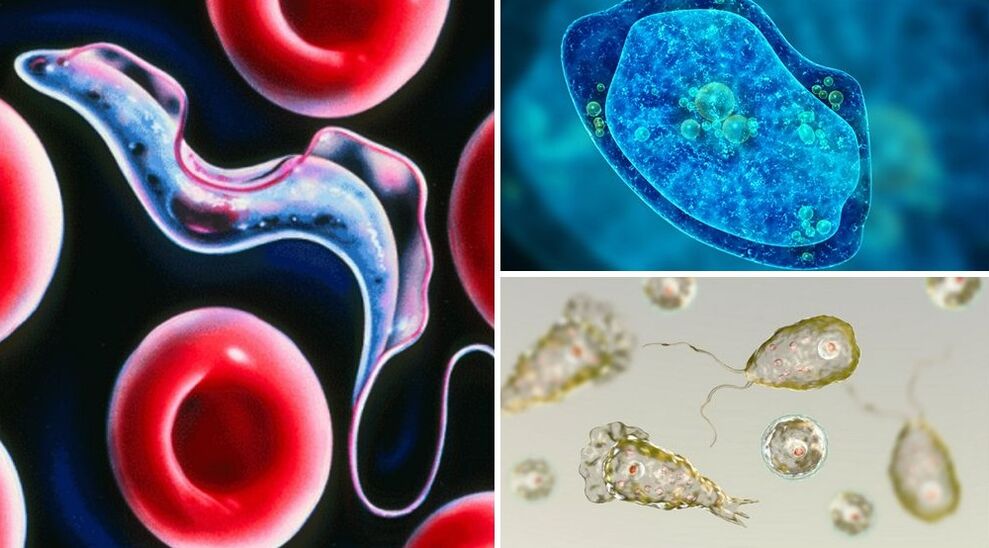
The body of a protozoa consists of cytoplasm and nucleus.The cytoplasm is bounded by the outer cytoplasmic membrane; it contains the organelles—mitochondria, ribosomes, endoplasmic reticulum, and Golgi apparatus.Protozoa have one or more nuclei.The form of nuclear division is mitosis.And the sexual process.It involves the formation of a fertilized egg.
The organelles for protozoan movement include flagella, cilia, and pseudopods; or they may not have them at all.Most protozoa, like all other representatives of the animal kingdom, are heterotrophic.However, there are also autotrophic ones among them.
The tolerance of protozoa to adverse environmental conditions is characterized by their ability to encapsulate, that is, form cysts.When a cyst forms, motor organelles disappear, the animal decreases in size, takes on a rounded shape, and the cells are covered with a dense membrane.The animal enters a resting state and resumes active life when favorable conditions arise.
Cysts are devices that not only protect but also facilitate the spread of parasites.Some protozoa (sporophytes) form oocysts and, during reproduction, sporangia.
Reproduction in protozoa is very diverse, ranging from simple division (asexual reproduction - biofile.ru) to quite complex sexual processes - conjugation and mating.
Protozoa live in a variety of habitats—marine, freshwater, moist soil.Parasitism became widespread.Many species of parasitic protozoa cause serious disease in humans, domestic and commercial animals, and plants.
Protozoa are able to move with the help of pseudopodia, flagella or cilia and respond to various stimuli (phototaxis, chemotaxis, thermotaxis, etc.).Protozoa feed on the smallest animals, plant organisms, and decaying organic matter; parasitic forms live on the host's body surface, body cavities, or tissues.
The means by which food enters the cell body are also different: pinocytosis, phagocytosis, osmotic pathways, active transport of substances across membranes.They digest incoming food in digestive vacuoles filled with digestive enzymes.Some of these photosynthetic intracellular symbionts, chlorella or chloroplasts (such as Euglena), are able to use photosynthesis to synthesize organic matter from inorganic matter.
Toxoplasma gondii
Toxoplasmosis (Greek toxon - arch, arc) is a disease caused by native single-celled organisms in the different parts of the human body where they have been introduced and multiplied.Toxoplasma gondii, the causative agent of toxoplasmosis, belongs to the protozoan genus Giardia.
Toxoplasma gondii is crescent-shaped, resembling an orange slice: one end of the parasite is usually pointed and the other is rounded, and can be up to 7 microns in length.Toxoplasma gondii moves by sliding.They penetrate the interior of the cell and rotate around their longitudinal axis.
Reproduction in Toxoplasma gondii is asexual and occurs by longitudinal division into two.Due to repeated longitudinal divisions in the host cell protoplasm, an accumulation of progeny parasites is formed, which is called a "pseudocyst".During the acute phase of infection, numerous pseudocysts are found in various organs of the infected organism.They are surrounded by a very vague membrane, apparently formed by the host cells, and do not have a shell of their own.Cells filled with this parasite are destroyed.The released parasites penetrate into new cells, where they divide again and form new pseudocysts.
When the infection becomes chronic, Toxoplasma gondii remains in true cystic form (they surround themselves with a special shell).Such cysts can persist in animals and humans for long periods of time (up to 5 years).Cysts are also found in the tissue of the eyes, heart, lungs, and some other organs.The number of Toxoplasma gondii in the cysts ranges from a few copies to thousands.
Giardia
Giardia is the simplest parasitic animal in the class Flagellate.Pear-shaped, 10-20 microns in length; the dorsal side is convex and the ventral side is concave, forming a sucker for temporary attachment to the epithelial cells of the host intestine.There are 2 oval nuclei and 4 pairs of flagella.It lives in the human intestine (mainly in children), mainly in the duodenum and less frequently in the bile ducts and gallbladder, causing giardiasis.Asymptomatic parasite carriage is common.Cyst infection occurs when protozoa enter the lower intestine through the mouth, through ingestion of contaminated food or water, or through dirty hands, for example.The onset is sporadic.Giardiasis is common throughout the world.
The causative agent of the disease is Lamblia Enteris.Giardia is a single-celled microscopic parasite.Giardia can withstand freezing and heating up to 50°C, but will die when boiled.Giardiasis is the leading parasitic gastrointestinal disease in the United States.According to INTERNET, up to 20% of the world's population suffers from giardiasis.When washing vegetables and fruits with uncooked water, drinking uncooked tap water or ice made from tap water may cause infection.The risk of illness is high when swimming in open water and in pools contaminated with Giardia cysts.Newborns can become infected during eruption and head birth during delivery.Infection by contact is rare, but due to the high prevalence of the disease it becomes quite real, especially among people with poor general hygiene skills.
Trichomonas
Trichomonas vaginalis does not form cysts and feeds on bacteria and red blood cells.Causes inflammation of the genitourinary system - trichomoniasis.The causative agent of the disease is sexually transmitted.Extrasexual infections (through shared toilet supplies, beds, etc.) are less common.It can be passed from a sick mother to a newborn baby girl.The disease may become chronic.If it spreads to the appendages, it can be difficult to treat.Trichomoniasis most commonly affects the vagina.There is a large amount of purulent discharge with an unpleasant odor; there is itching and burning in the vagina.In men, the symptom is inflammation of the urethra (urethritis) with only a small amount of mucus discharge.
Amoeba
Amoebas live in fresh water.Body shape is not static.Moves very slowly (13mm/hour).It moves with the help of pseudopodia, flowing from one part of its body to another: either shrinking into a ball or spreading its "tongue legs" to the sides.
Pseudopodia can also be used to capture food.During feeding, the amoeba's body flows around the food particle from all sides, eventually entering the cytoplasm.Digestive vacuoles appear.This type of eating is called "fabititosis."Food consists of bacteria, single-celled algae, and small protozoa.Solutes from the environment are absorbed through pinocytosis.
The body of the amoeba has a contractile or pulsating vacuole.Its function is to regulate the osmotic pressure in protozoa.Reproduction is asexual, by mitosis, which then splits the amoeba's body in two.Amoeba of the genus Entamoeba live in the human digestive tract and are of paramount importance in medicine.These include dysentery or Entamoeba histolytica.
malaria Plasmodium
The parasite Plasmodium causes malaria, which is accompanied by fever, blood changes, and enlargement of the liver and spleen.There are four forms of malaria: three-day malaria, four-day malaria, tropical malaria and ovale malaria.The source of the disease is a malaria patient, and the carrier is a female Anopheles mosquito.Female mosquitoes become infected by sucking the blood of sick people and are thus able to transmit the malaria parasite.Healthy people become infected when bitten by a mosquito infected with Plasmodium, and the pathogen enters the body through their saliva.Plasmodium travels through the bloodstream to the liver, where it undergoes its first (tissue) developmental cycle before entering the bloodstream and penetrating red blood cells.Here they complete the second (red blood cell) developmental cycle, which ends with the breakdown of red blood cells and the release of pathogens into the patient's blood, accompanied by fever.